This is a rather sneaky skin disease for several reasons. Often individuals are reluctant to completely undress for their skin examinations. In such instances, lichen sclerosus can remain undiagnosed and the opportunity to prevent complications will be missed. Sometimes patients will dismiss their symptoms as trivial or to ageing or are uncomfortable broaching the topic. On the other hand, when was the last time you had a complete skin exam and the dermatologist asked you if you experienced pain or itching during sex, had discomfort with urination or defecation or when wiping yourself afterwards, or had irritation in the genital or anal areas?
It is important to be checked for this skin disease because it has a predilection for the genital area, can cause scarring and is associated with a risk of developing squamous cell carcinoma if left untreated. Sometimes patients are not symptomatic but the disease is present.
 Lichen sclerosus is more common in women but can occur in men. In men it affects the head of the penis and foreskin. Typically there is itching, discomfort or pain with intercourse. There may be irritation at the tip of the penis, and difficulty urinating. Painful erections, erectile dysfunction, dribbling, poor urine flow, and pain on urination can be symptoms. Sometimes there is a whitish discoloration and bruising on the penis.
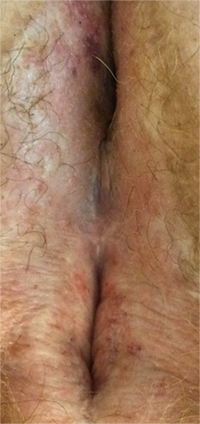
In women, the constellation of symptoms include: soreness, itching, painful intercourse, sores, papercut-like tears in the skin, bruising, blisters, constipation, pain on urination. The skin appears thin, shiny, wrinkled, and white. Patches of red and purple may be present. In severe/untreated cases, the vaginal introitus can be very narrow and there can be total loss of labia minora.
In general, treatment is topical and is very effective if started promptly. It is common for patients to not realize how much they were suffering until they start treatment and symptoms resolve.